|
|||
| >
ADAMLink
Home |
|||
|
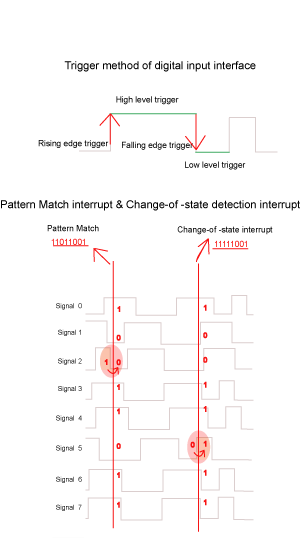
One of the most obvious advantages is realized when we consider the fact that a CPU will deal with interrupts one-by-one. While the CPU is busy dealing with an interrupt, it will ignore other interrupts! Both Pattern Match and Change-of-State make it possible to simultaneously monitor several channels, and are therefore very useful in applications with many input channels. Pattern Match is for applications where you want a specific signal pattern to trigger an action. All the digital input channels will be monitored while they continuously change, and when all input channels have the wanted state simultaneously, an interrupt will be created. Change-of-State is mainly for applications where you want to monitor irregularities. For example, if monitoring eight alarms in a building, the normal state would be 11111111. If the third alarm in a building malfunctions or is actually triggered, the third input channel changes to 0, making the input pattern 11011111. This will make the Change-of-State function create an interrupt. Combining the two functions can allow for more intelligent applications. Let's continue with the example above. Pattern Match combined with Change-of-State could be used to differentiate the alarms. Change-of-State can trigger low-priority alarms since one abnormal channel could simply mean that an alarm has malfunctioned and needs a repairman. However, if all channels simultaneously change to 0, it would mean the whole alarm system is down! Pattern Match could be set to monitor the input channels for 00000000 reading, and then trigger a high-priority alarm if this pattern occurs. The Pattern Match and Change-of-State functions make it possible to design more intelligent solutions for digital input signals. There is a steady increase of channels on today's digital input cards. These functions show how you can take advantage of it.
|
 Contact
your Geo-RegionalIndustrial
I/O Product
Specialist
... click
here Contact
your Geo-RegionalIndustrial
I/O Product
Specialist
... click
hereAdvantech
Industrial Automation ADVANTECH
Automation 1320 Kemper Meadow Dr., Ste 500, Cincinnati, OH 45240.
877-294-8989
|
||