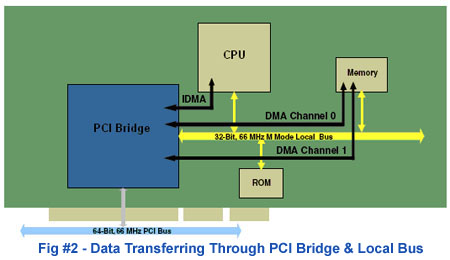
PCI bus masters can perform data transfers without local CPU help. Moreover, CPU's can even be treated as one of the bus masters as well. The PCI SIG group has released PCI rev 2.1 which supports concurrent PCI operations. This new specification allows a local CPU and bus master to work simultaneously. How does the bus master work? The answer lies in which device has the right to access it. An arbitration scheme is applied according to system logic. Every bus master device has unique request (REQ#) and grant (GNT#) signals. The bus request signal REQ# tells the arbiter to request the right to access the bus. The grant signal indicates to the master device that access to the bus has been allowed.
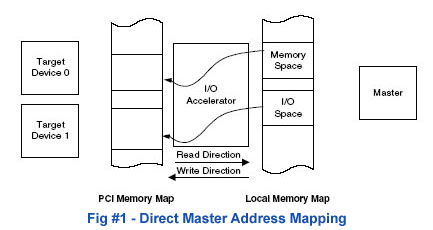
With the PCI BUS master DMA technology, modern data acquisition cards can perform much higher speed I/O than traditional cards. Previously, PCI bus bandwidth is sufficient for 100KS/s data acquisition. However, as A/D technology evolves, 30MS/s or higher sampling rate has become possible, making the PCI bus bandwidth a bottleneck in data transfers. Applying PCI bus master DMA is one of the best methods to break through bandwidth limitations without changing the physical bus interface.
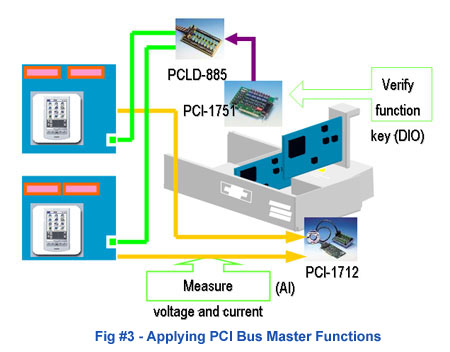
Advantech provides a wide range of Analog I/O, Digital I/O and Multifunction cards that support the PCI bus master DMA technology. Advantech’s high speed I/O family adopts advanced technology while providing a user friendly interface through versatile drivers like OCX, Labview driver, or DLL drivers for VC, VB, Delphi, and BCB users. With Advantech's high speed data acquisition cards, Test & Measurement users can enjoy cost effective PC-based solutions without additional hardware. For example, an IC tester machine can use the PCI-1755 to generate I/O patterns up to 80MHz, and verify the result with the same card. Furthermore, a cell phone test station can verify the audio and circuit functions with only one PCI-1712 multifunction card.
|